


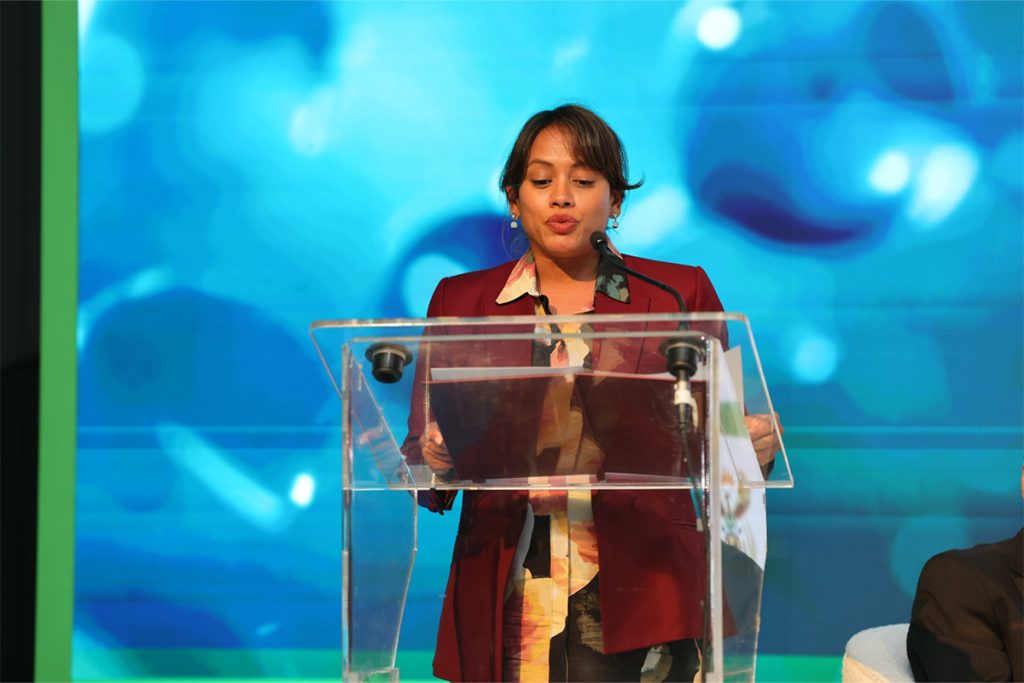
Green Hydrogen Summit
Programme Director,
Distinguished panellists,
Industry stakeholders,
and delegates.
Welcome to this session on offshore wind energy development in South Africa. I have recently held positive engagements with key stakeholders across the sector. This includes productive discussions with two of the panellists joining us today. These interactions reinforce a shared commitment to our national energy transition and the establishment of a competitive energy market.
I will leave the deep technical mechanics of offshore generation to our expert panel today. My focus remains strictly on the policy architecture that enables their work.
We cannot hide from the reality of our most recent GDP contraction and stagnant national GDP growth over the last number of years. South Africa requires urgent economic revitalisation. Government must provide the policy solutions that inspire business and investor confidence. We must create the macroeconomic environment necessary for businesses to grow. A secure, dependable energy supply is the non-negotiable for this growth to be realised.
Wind energy is especially relevant for the development of new industries such as green hydrogen production. If we are to definitively deal with unemployment in South Africa, we must do everything needed to revitalise our existing job-intensive industries. We must also take every measure to support the establishment and growth of new industries like green hydrogen.
Reliable electricity is the catalyst required to turbocharge our economy. It expands industrial capacity, and in doing so, generates sustainable employment. It delivers vital cost of living relief to our citizens. Our overarching priority is exceptionally clear. We must secure reliable and affordable energy.
Achieving this requires a highly competitive energy ecosystem.
It is not the role of the state to predetermine or mandate specific energy technologies. Government should not arbitrarily choose one energy source over another. We must instead establish a transparent, open market. Energy sources must be allowed to compete on cost and efficiency. Conferences and platforms such as this are therefore critical. They facilitate the rigorous discourse required for the market to identify the best solutions.
South Africa occupies a highly strategic geographical position. Our georgraphic position offers incredibly consistent coastal wind profiles. We must harness this natural advantage. International trade regulations increasingly penalise carbon-intensive supply chains. Our natural resources therefore allow us to adapt proactively to this shifting global trade environment. By integrating new generation capabilities, we position our manufacturing sectors to remain globally competitive. We can attract foreign direct investment by offering clean, dependable power to energy-intensive industries.
We must pursue this development responsibly. Offshore infrastructure interacts directly with sensitive marine environments. We have a responsibility to protect our environment for generations to come. All development must be executed sustainably. We must leverage constantly evolving technologies to our advantage. Modern engineering allows us to mitigate environmental impact effectively. We can responsibly navigate the complexities of marine spatial planning.
Technological advancement ensures we can safeguard our wildlife and seabed ecosystems while successfully expanding our energy grid. Environmental stewardship and energy generation must operate in tandem.
Translating our renewable energy potential into operational capacity requires a predictable and enabling regulatory architecture. We must establish a rule-based legislative framework. This framework must govern offshore development with precision.
In my engagements with industry stakeholders one clear message has consistently come through. Investors need transparency and a reasonable amount of predictability. Large IPP projects span multiple years of construction and rounds of investment. It is critical that industry is able to clearly follow the progress of their applications and have certainty on procurement and payments. As government, we hear your concerns and are hard at work ensuring our energy regulatory system works to the benefit of all.
Through Operation Vulindlela, the government is systematically dismantling historical administrative bottlenecks.
We are extending this reformist discipline directly to the new generation sector. The Electricity Regulation Amendment Act provides the structural foundation for an open market. An independent transmission system operator will guarantee fair market access. Transparent procurement processes give institutional investors the certainty they need to invest.
We are cutting red tape. We are working towards shortening project approval timelines. This empowers the private sector to respond swiftly to energy demands. A capable state sets clear policy directives. It then allows the open market to deliver cost-effective solutions.
Institutional investors require a stable policy environment. Project developers need protection from arbitrary policy shifts. When the state provides objective benchmarks, private enterprise can accurately price risk. When risk is accurately priced, the cost of capital decreases. Reduced bureaucratic friction further lowers this cost. A lower cost of capital directly correlates to lower tariffs for businesses and households.
Our focus is on building an institutional environment that rewards efficiency. Rigorous competition between electricity generators will produce the efficiencies that will lead to cheaper electricity for everyone. I look forward to the insights from our panel today. I thank you for your commitment to South Africa’s economic and energy future.
MS ALEXANDRA ABRAHAMS
DEPUTY MINISTER OF ELECTRICITY AND ENERGY