


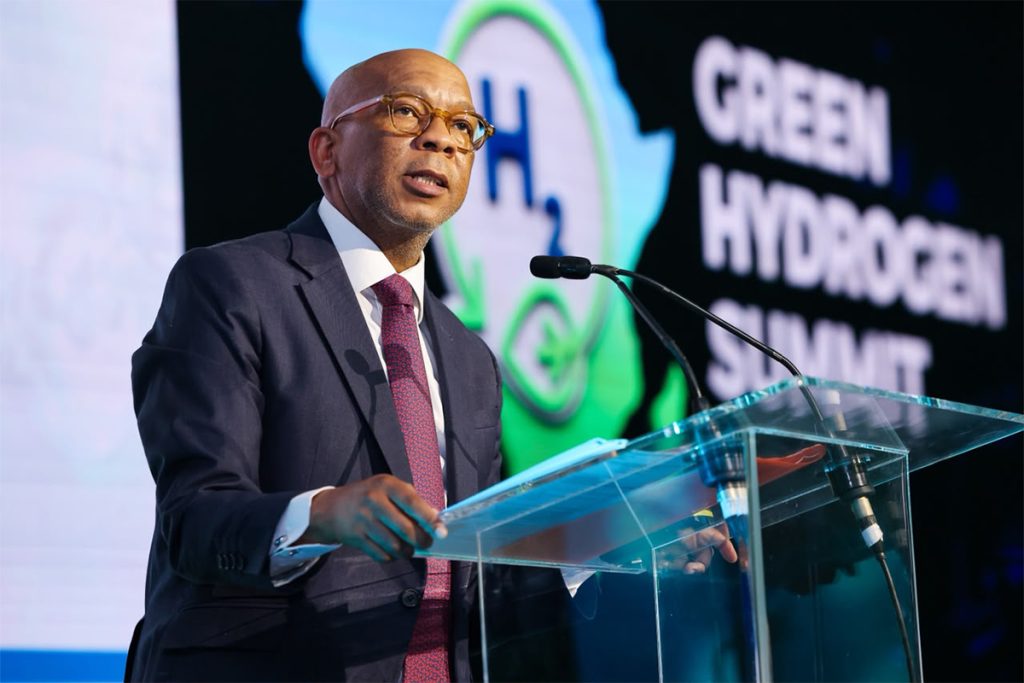
Opening Address By Minister Kgosientsho Ramokgopa Mp
Africa Green Hydrogen Summit 2026
Cape Town | 15 September 2026
From PowerPoint to gigawatts
His Excellency President Cyril Ramaphosa,
Ministers and Deputy Ministers,
African Ministers and representatives of the African Union,
Premiers and representatives of the Eastern, Northern and Western Cape Provinces,
Members of the Portfolio Committee and Select Committee for Electricity and Energy,
Ambassadors and members of the diplomatic community,
Leaders of development finance institutions, industry, organised labour, academia and civil society,
Project developers, investors, technology partners and prospective offtakers,
Distinguished guests,
Ladies and gentlemen,
Good morning, and welcome to Cape Town for the 2026 Africa Green Hydrogen Summit.
Earlier this month, the United Nations supported a call for Africa to be represented at its true geographical scale on the world map. That correction is about more than cartography. It challenges the world to see Africa in its proper proportion, not only as a continent of immense land, sunlight, wind and mineral resources, but as a continent capable of building the industries of the future.
In the emerging green hydrogen economy, our true scale must be reflected in more than potential. It must be reflected in the gigawatts we build, the technologies we develop, the industries we establish and the value, skills and jobs we retain on African soil. A more accurate map should be accompanied by a more accurate account of Africa’s economic agency and productive capability.
Mr President, when we gathered at this Summit last year, you challenged all of us to move the green hydrogen sector from PowerPoint to gigawatts.
That challenge altered the standard against which our work must be judged. It was no longer enough to speak about the quality of our renewable resources, the number of projects in a pipeline or the value of investments that may one day be made.
It required that we must be able to show which projects are advancing, what stands between them and final investment decision, who is responsible for removing those constraints, how infrastructure will be delivered, where the customers will come from, and how the investment will create productive capacity and public value that support a transformational and inclusive economy.
Mr President, Programme Director,
Of course, our work did not begin in 2025. South Africa has invested for almost two decades in hydrogen research, innovation and institutional capability. The Hydrogen South Africa programme helped build scientific knowledge, specialist skills, intellectual property and experience across hydrogen and fuel-cell technologies. The Hydrogen Society Roadmap broadened that foundation by setting out how hydrogen could contribute to transport, industry, power, buildings and economic development. The Green Hydrogen Commercialisation Strategy then shifted the emphasis towards commercially viable projects, markets and industrial value chains.
The work of the past year has been to connect, more purposefully, those policy and research foundations to a disciplined programme of execution. This has required us to look beyond the headline value of a proposed investment and examine the actual condition of each project.
Working with the Industrial Development Corporation, the Green Hydrogen JET IP Programme Management Unit, the Department of Trade, Industry and Competition, GIZ and other partners, we have supported the application of a common Power-to-X Project Development Standard to the national pipeline.
It also helps us identify what is preventing a credible project from moving forward. One project may require additional engineering. Another may need support to structure a bankable offtake agreement. Yet another may depend on transmission, port or water infrastructure that falls outside the control of the developer. Unless these constraints are identified precisely, public institutions cannot direct their effort or resources intelligently.
The standard is not a mechanism for declaring winners through administrative preference. It is a mechanism for improving the quality of project development, directing support towards defined gaps and providing investors with a clearer account of project readiness.
This discipline allows us to distinguish between three related, but different, parts of the national programme. The First Wave is, therefore, the priority portfolio that the President will announce. The National Green Hydrogen Deal Book presents the wider pipeline of credible opportunities to investors, development partners and potential customers. The Second Wave is the next group of projects that must now be assessed and matured for possible inclusion in the priority portfolio.
These distinctions matter. A project’s inclusion in a Deal Book is not the same as reaching final investment decision. Priority status is not the same as construction. A memorandum of understanding is not a bankable customer agreement. An expression of investment interest is not committed capital. The credibility of the programme depends on government, developers and partners reporting each milestone for what it is.
Priority status must also carry obligations. Projects receiving focused institutional support will be expected to meet defined development milestones. Where milestones are repeatedly missed without a credible recovery plan, government and its partners must be prepared to redirect scarce project-preparation resources towards projects with a stronger route to implementation. This is how a managed portfolio should operate.
Programme Director, delegates,
A second part of the delivery system is the Three Capes Partnership. The Eastern, Northern and Western Cape Provinces formalised their cooperation through a memorandum of understanding in 2023. The strategic value of the partnership lies not simply in geography, but in combining complementary capabilities within one national production, industrial and export platform.
The Northern Cape brings some of the country’s strongest solar and wind resources, the land required for large-scale production and the prospect of new infrastructure and industrial activity around the Boegoebaai corridor. The Western Cape brings Saldanha and Cape Town, maritime and aviation demand, access to international trade routes, research capability and industrial opportunities linked to sustainable fuels. The Eastern Cape brings the Coega industrial platform, port and logistics capability, renewable resources and the potential to connect hydrogen with chemicals, manufacturing and domestic industrial demand.
Mr President, Premiers
These are not three provincial propositions competing for the same attention. They are complementary parts of a national, and increasingly, a regional value chain. Production in one location may depend on equipment manufactured in another, port infrastructure in a third and customers elsewhere in South Africa, on the continent or abroad.
The task now is to convert Provincial cooperation into coordinated delivery. We need a consolidated view of the project pipeline and its shared infrastructure requirements. We must sequence decisions across electricity generation, transmission, water, ports, logistics, spatial planning and environmental authorisations. A project schedule cannot be credible if each public institution plans its contribution on a different timetable.
This coordination must extend to municipalities, organised labour, local businesses and host communities. Communities should not encounter a green hydrogen project for the first time when land is required or construction is about to begin. Local benefit, skills development, employment, procurement and community participation must be designed early enough to influence the project, not added later as a compliance exercise.
Water planning requires particular discipline. Several of the regions with strong renewable resources are water constrained. Project design must therefore consider water sources, treatment, recycling, desalination where appropriate, brine management and the infrastructure required to deliver water without competing with basic human needs or existing economic activity. The credibility of a green product depends on the integrity of the full resource system through which it is produced.
The launch of the Eastern Cape Green Hydrogen Strategy at this Summit strengthens the provincial foundation of the partnership. It provides a basis for aligning projects, infrastructure, skills, industrial development and investment promotion. The same implementation discipline must be maintained across all three provinces so that investors encounter an integrated national proposition rather than disconnected project and infrastructure processes.
The third area of work is the development of practical domestic applications. We launched the 2026 Africa Green Hydrogen Summit at Eskom’s Research, Testing and Development facility in Rosherville. At that launch, Eskom demonstrated its research programme on the co-firing of ammonia in coal-fired generation.
This work is important because the hydrogen economy will not be built only through export projects. It must also be informed by evidence about where hydrogen and its derivatives can contribute within South Africa’s own energy and industrial system.
Internationally, ammonia co-firing work has advanced at Hekinan Power Station in Japan and is being considered or developed in South Korea and China. These programmes are testing whether ammonia can displace a portion of coal in existing generation while maintaining safe and reliable plant operation.
Mr President,
For South Africa, the strategic question is whether green ammonia co-firing can contribute to reducing the carbon intensity of appropriate parts of the existing coal fleet while extending the useful life of suitable stations responsibly. Co-firing may reduce coal consumption and the associated carbon and sulphur emissions. However, Nitrogen oxide performance depends on combustion temperatures, operating conditions, blend ratios and emissions-control measures. The work at ESKOMs research facility should accordingly evaluate technical performance, system reliability, emissions and cost across different operating conditions before any judgement is made about larger-scale application.
The Rosherville programme should be treated as part of a wider learning system. Test results must inform engineering standards, plant-safety protocols, skills requirements, environmental assessment and the commercial assumptions used by prospective suppliers. This is how research becomes implementation capability. It allows South Africa to make decisions from evidence generated under local operating conditions rather than importing conclusions developed for different plants and electricity systems.
Programme Director, the fourth area of work has been the mobilisation of investment, technology and markets. Green hydrogen and Power-to-X projects are capital intensive. They require risk capital during project preparation, long-term construction finance, enabling infrastructure and customers willing to enter arrangements that can support project finance.
South Africa has therefore pursued a diversified partnership approach. We have engaged European partners, China and other strategic partners. We have worked with project developers, renewable-energy and electrolyser manufacturers, development finance institutions, commercial lenders, infrastructure providers and prospective offtakers.
Our engagement with the European Union and Team Europe has covered project preparation, blended finance, certification, skills, technology and access to markets. The Development Bank of Southern Africa project-preparation facility, supported by the European Union and KfW, is intended to address one of the least visible but most persistent constraints in the sector.
A large project cannot move from an attractive concept to financial close without detailed engineering, environmental work, commercial structuring, legal advice and transaction preparation. This work is expensive and must be completed long before construction finance becomes available. The project-preparation facility is designed to help credible projects undertake this work and reduce the risks that prevent them from reaching bankability.
The proposed facility includes a 20 million euro grant from the European Union and is expected to mobilise approximately 200 million euro from KfW and other European development finance institutions. These figures should be understood in their correct categories. The grant supports preparation and risk reduction. The wider mobilisation is financing that will remain subject to project quality, due diligence and the applicable approval processes.
The H2SA programme is also entering its second phase and expanding its mandate to include the battery value chain. Germany is being joined by the European Union, the Netherlands and Denmark, with additional funding supporting skills, capability, market development and industrial value chains across technologies that will increasingly interact within the energy system.
Our engagement with Europe must, however, extend beyond development support. Several South African projects are pursuing European demand. Their prospects depend on compliance with evolving sustainability, traceability and certification requirements. More fundamentally, they depend on moving from market interest to credible long-term offtake.
Certification is not a peripheral technical matter. It will determine whether a product qualifies for a particular market, whether its emissions profile can be verified and whether a buyer can count it towards regulatory obligations. South Africa must participate actively in the development and application of these systems so that standards protect environmental integrity without becoming an unjustified barrier to African producers. Project developers must build traceability and measurement into their designs from the beginning rather than attempt to add them shortly before export.
We have also broadened our engagement with China. At the South Africa-China Electricity and Energy Infrastructure Investment Conference in Beijing in August, green hydrogen formed part of a wider investment proposition covering electricity infrastructure, renewable-energy equipment, electrolysers, storage, manufacturing, skills and technology partnerships.
China has substantial capability across renewable-energy and electrolyser supply chains. Our objective is not to build a relationship based only on imported equipment. We are seeking investment that supports South African projects and expands domestic productive capability through localisation, skills development, technology transfer, component manufacturing and, where commercially viable, access to customers and offtake.
These engagements are now being taken into an after-care phase. The value of an investment mission does not lie in the number of meetings held or declarations made. It lies in whether opportunities are assigned to responsible institutions, technical and commercial questions are resolved, credible investors are supported through the regulatory environment and proposals are converted into investment decisions.
We are also working to mobilise domestic institutional capital. South Africa has development finance institutions, commercial banks, pension savings and industrial balance sheets with the capacity to participate in this emerging sector. A South African green hydrogen industry cannot be built on external capital alone.
Domestic investors must be able to understand the risk profile, development stages and instruments through which they can participate.
The task is not to persuade domestic capital to ignore risk. It is to identify risks accurately and allocate them to the parties best able to manage them. Technology risk, construction risk, market risk, policy risk and infrastructure risk cannot all be transferred to the state or priced into a single expensive financing instrument. A credible financing structure will combine sponsor equity, commercial finance, development finance and concessional support in proportions justified by the project and the public value it creates.
Across all these engagements, offtake remains decisive. Government can support certification, standards, market access and investment facilitation. It can help create early demand where there is a justified public purpose. It cannot indefinitely substitute for a customer or carry commercial risks that properly belong with project sponsors and buyers.
Prospective offtakers must move from non-binding interest to commercial structures capable of supporting finance. Developers must demonstrate that the product they intend to make has a customer, that the customer’s requirements are understood, that certification can be achieved and that the price pathway is credible.
Domestic and regional markets are equally important. Green ammonia can support fertiliser production and food security. Green hydrogen can contribute to lower-emissions iron and steel, mining, chemicals and selected heavy-transport applications. Sustainable fuels can serve aviation and maritime markets. Building demand closer to production can reduce exposure to a single export market and deepen the industrial value retained in the region.
Our continued work with African partners, including through the Africa Green Hydrogen Alliance, is therefore focused on practical areas where cooperation can reduce cost and improve market scale. These include standards, certification, project preparation, infrastructure corridors, skills and the development of regional demand. The President will address the wider continental proposition. The Department’s task is to translate that proposition into programmes and investable opportunities.
The announcements at this Summit should be understood as parts of one delivery system. The National Green Hydrogen Deal Book provides a structured presentation of the project pipeline. Project-preparation facilities help close defined development gaps. International partnerships support finance, technology, skills and market access. Certification helps demonstrate product integrity. Offtake provides the demand without which production cannot be financed.
The same discipline will guide the Second Wave. Projects admitted to the priority portfolio will have defined development gates and milestones. The Department will monitor progress, coordinate action on blockages that fall within government’s responsibility, and connect projects to appropriate preparation and financing instruments.
We will support engagement on certification and markets, and work to align project requirements with electricity, transmission, water, port and logistics planning.
The global hydrogen sector is entering a more exacting phase. Capital and customers are distinguishing between announcements and executable projects. South Africa should not retreat from that discipline. We should apply it more rigorously to our own programme.
We possess substantial advantages: high-quality renewable resources, an established industrial base, platinum group metals, ports and logistics, scientific capability, financial institutions and experience in managing complex energy and industrial systems. Those advantages will not convert themselves into investment. They must be organised through credible projects, coordinated infrastructure, capable institutions, competitive products and customers.
The account we place before the Summit is therefore not that the work is complete. It is that the delivery platform is becoming more coherent. We have introduced a common project-development standard. We are managing the pipeline more deliberately. We are strengthening coordination through the Three Capes. We are testing practical domestic applications. We are mobilising preparation finance, investment, technology and markets. We are establishing the basis for a stronger Second Wave.
None of these measures, on its own, constitutes a gigawatt. Together, they create the conditions under which credible projects can reach final investment decision, enter construction and produce at scale.
Mr President,
You issued the challenge that established this standard of accountability. You will now announce the First Wave and identify the first tangible evidence that a South African project is crossing from development into implementation. Our responsibility is to ensure that the remaining projects follow, and that the Second Wave is stronger because we have applied the lessons of the first.
It is my honour to invite the President of the Republic of South Africa, His Excellency President Cyril Ramaphosa, to address the 2026 Africa Green Hydrogen Summit.
Dr Kgosientsho Ramokgopa
MINISTER OF ELECTRICITY AND ENERGY